what separates a good marketing partner from a vendor (& why it matters)
If you've ever hired a print shop to make business cards, you know exactly how that type of relationship works. You give them the design, the quantity, the deadline. They print the cards. Everyone's happy. No one expects the print shop to ask about your company's five-year growth goals first.
That's the thing about vendors. They're great at exactly this: Clear ask, clear deliverable, done.
So when business owners start looking for marketing help, they might bring that same mindset. They've got a task in mind — a new logo, a few social posts, maybe a round of paid ads — and they're looking for someone to execute it. Tell them what you need, let them handle it, move on.
Then they sit down with an agency that operates as a digital marketing partner, and the first meeting doesn't go the way they expect. Instead of a quote for the logo, there are questions:
Who's your target customer?
What's working right now and what isn't?
What does success look like six months from now, not just at the end of this project?
It can feel like a detour. But it's not. It's the whole point.
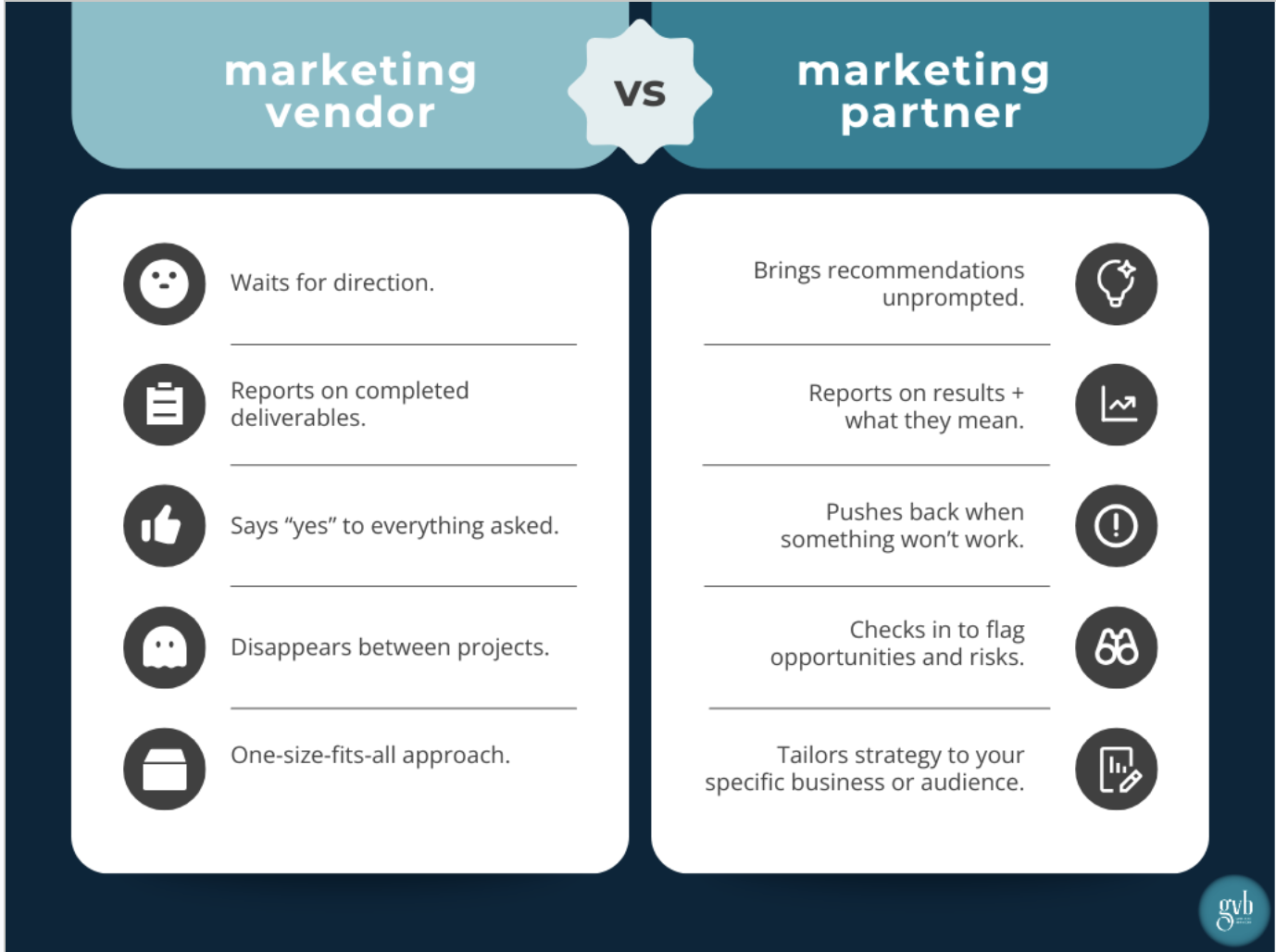
A vendor executes what you ask for. A partner helps you figure out what you should be asking for in the first place — and that difference shapes everything about how the relationship works from there.
what is a vendor?
Vendors are companies that sell goods or services to another business or organization in exchange for payment. They typically offer a defined set of products or services to a wide range of industries — the same print shop that makes your business cards might also make cards for the dentist down the street.
Vendor relationships are task-based, reactive, and transactional by nature. You have a specific, known need. You give marching orders, the vendor executes, and you call it a success if they delivered the thing on time and on spec.
If your office wifi goes down, you call your IT vendor to fix it. You're not looking for a conversation about your company's tech roadmap; you just need it working again.
In marketing, vendor relationships might look like:
A company ordering volunteer event T-shirts from a local screen print shop
A nonprofit hosting a fundraising gala and hiring an AV company to run lights and sound
A restaurant booking a photographer for one afternoon to shoot new menu items
A small business hiring a proofreader to review a one-off brochure before it goes to print
None of this is a bad thing. Vendors are the right fit for exactly these kinds of needs: one-off projects, clearly scoped tasks, a known deliverable with little ambiguity about what "done" looks like. The trouble starts when a business applies this same mindset to a need that isn't actually one-off or clearly scoped — like an ongoing marketing strategy.
what is a marketing partner?
A marketing partner is a company or consultant that’s interested in your business’s outcomes, not just outputs. They aim for long-term client relationships where they can really get to know the business, its goals, and vision. Partner marketing agencies often feel like an extension of your own team.
Marketing partners ask "why" before "how." They bring strategy and proactive ideas to marketing initiatives, and they're not afraid to challenge the brief if they see a better path to the brand's goals.
In practice, this might look like a digital marketing partner noticing that a client's paid ad budget is being wasted on the wrong audience and flagging it before it's asked about, or pushing back on a request for "more social posts" by pointing out that the real issue is an outdated website nobody's converting on.
A vendor moves your to-do list forward. A partner moves your business forward — even the parts you haven't thought to put on the list yet.
why the distinction matters to brands and businesses
Successful businesses might have strong vendor and marketing partner relationships. There’s no rule that you have to use one or the other. But there are potential costs to both if you're not intentional about which one you're actually working with.
the cost of a vendor-only relationship
When you work with vendors, your internal team does a lot of the heavy lifting. You're the one doing the strategic thinking — figuring out what the business needs, translating that into a brief, and making sure the pieces add up to something bigger. The vendor executes well, but they're not the ones connecting the dots.
For a single project, that's manageable. But if all of your marketing runs through vendor relationships — a freelancer for social posts here, an agency for a website refresh there, a consultant for an ad campaign — someone still has to be the one tying it all together into a coherent strategy. If that's not anyone's job, the gaps show up as inconsistent messaging, disconnected campaigns, and a brand that feels different depending on which vendor touched it last.
the cost of a bad partner match
Not all partners will be the right fit for your needs, either. It’s important to find an agency or consultant that takes the time to understand your business before making recommendations — not one that leads with a strategy deck before they've asked a single question about your goals. Otherwise, you might find yourself overpaying for "strategy" that's really just opinion, dressed up in strategic language but not actually grounded in your business, your customers, or your data.
A bad partner match can be worse than a straightforward vendor relationship, in some ways. You're paying a premium for strategic thinking — so if that thinking isn't sound, or isn't specific to your business, you're paying more for less.
The real value of a good partner is that they save you time by thinking ahead, not just behind. They work to catch problems before they cost you and spot opportunities before you'd have thought to look. A bad match gives you none of that upside — just the higher price tag.
where gvb fits
We've seen both sides of this: the businesses that just needed a vendor, and the ones who came to us worn out from vendor relationships that never quite added up to anything bigger. It's part of why we start every relationship with a real conversation, not a proposal. We'd rather understand where you're headed before we tell you how to get there.
We're not the right fit for every project, and that's okay. But if you're figuring out what kind of help you actually need or how to choose a digital marketing partner, we're happy to just talk it through — no pressure.