AI vs. human creativity: why brands still need the human touch
Business owners and working professionals have heard the same AI-generated content “hacks” for years: Use Claude for social posts, let Gemini answer email, ask ChatGPT to turn last-minute notes into tomorrow’s blog.
But producing words faster is not the same as creating content people trust. The brands that benefit most from AI use it to accelerate human thinking, not replace it.
There’s no denying that large language models (LLMs) and AI tools can spit out content in seconds. The real question isn't "Can AI write content?" What brands need to be asking is: "What is our content actually for?"
Is the goal to ~satisfy the algorithm~ with a steady stream of posts? Or are you trying to attract potential customers, retain loyal clients, demonstrate how your business solves real problems, establish authority, and generate leads and conversions? AI can support that work, but it can’t decide which of those outcomes matters most, or what your audience needs to hear to take the next step.
If content is just words on a page, then sure, AI has this whole thing figured out. But people now recognize “AI slop” quickly, and the truth is that valuable content does more than fill a page or a social media feed. It builds relationships, communicates hard-earned expertise, and earns trust. And as someone who's spent her entire life obsessed with words, that's where this topic gets personal.
AI vs. human content: the stories AI can't tell
My personal relationship with language and words helps explain why I see human experience as the real source of valuable content.
My love affair with words began at a young age.
As a child, I loved learning the lyrics to my favorite songs and serenading my family. One of my favorite places was the local library, where stories carried me beyond my rural Indiana hometown and introduced me to lives unlike my own. More than once, my mom found me fast asleep, forehead resting on the book that had lulled me to dreamland.
When I was old enough for school, first quiet reading time and then English class became the best parts of my day. Crafting my own stories came naturally. I can still remember the pride I felt when one of the more fiery high school English teachers told my parents, “That girl can write her ass off!”
I wonder if anyone has ever thought Claude or Llama could “write their asses off.” 🤔
That lifelong attention to language eventually became a career. Working with businesses across industries taught me firsthand that content earns attention and trust when it reflects a real audience, a clear point of view, and evidence the reader can use.
That ability is not an innate gift. It comes from decades of reading, writing, revising, studying, and learning. Each client and project has taught me that good content depends on hundreds of small human judgments:
What is the audience really asking?
Which details matter, and which are just noise?
What evidence supports the claim?
What is better left unsaid?
An LLM can predict what word likely comes next. It can't draw on years of client conversations, failed experiments, editorial feedback, and lived experiences to make strategic decisions about what should be said and why.
AI tools certainly couldn’t experience, reflect upon, and write an origin story like the one above. I mean, sure, they could regurgitate someone’s origin story (or more likely, remix thousands of origin stories they've seen before). But LLMs never had spunky English teachers or lines on their forehead from falling asleep mid-page. They've never learned from a failed project, a difficult client conversation, or a hard-earned lesson.
Those experiences shape how we as humans think, communicate, and connect with other people. They aren't things that can be trained, scraped, or predicted.
So no, I don't think AI is replacing writers anytime soon. But I do think it's changing how we work and how we can best support clients. And when used responsibly, that's not necessarily a bad thing.
what AI is good at (and how to use AI for content creation)
Think of AI as a writing assistant or first-time intern, not a replacement for human judgment, experience, and expertise. Remember that LLMs work by predicting patterns in language based on training data, which makes them useful for some content tasks but also prone to specific limitations.
content ideation and brainstorming
use cases: brainstorming topics or ways to expand upon your existing content strategy
LLMs can be helpful in coming up with ideas for social posts, blogs, campaigns, or other marketing initiatives because they can rapidly synthesize information from thousands of high-performing examples. So if you're writing about remote work trends, an LLM might suggest content angles like productivity tools, mental health impacts, or geographic pay disparities. These ideas are rooted in patterns the AI learned from successful articles, but it doesn’t mean the same angle will work for your audience. Their value is in helping you react, refine, and find a more distinctive idea.
The same principle applies to headlines, social post angles, and content expansions:
AI tools can generate quantity and variation quickly, which can be genuinely useful when you're stuck.
LLMs don't generate true novelty; they remix existing formulas, so expect ideas to feel somewhat familiar, safe, or mainstream.
Your human expertise is where differentiation happens. You know your audience, your competitors, and your brand voice in ways even the best AI assistant doesn't.
the takeaway: Use the AI output as a starting point, not a finished strategy. Filter for angles that align with your audience's actual needs (not just what patterns suggest), combine ideas, and discard the generic ones. Then develop 2–3 angles deeper with your own expertise.
time-consuming content tasks
use cases: transcribing interviews and meetings, summarizing dense research, creating writer outlines, formatting source materials
I’m a big believer that AI is a productivity tool, not a replacement for human thought and creativity. Think of it this way: What can we automate in the process so our writers and marketers can spend more time in their creative flow state?
LLMs can be used to reduce time spent on administrative and research-heavy tasks because they can process and reorganize large amounts of information quickly — freeing up a writer’s cognitive space for the creative decisions that actually require human judgment (tone, narrative structure, original insights).
For example, if you have a 45-minute customer interview recording, an AI tool can transcribe it and generate a structured summary highlighting key quotes, pain points, and actionable insights in minutes — work that might otherwise take a writer 2–3 hours to do manually.
AI tools work best on mechanical tasks with clear inputs and outputs. Transcription, summarization, and information reorganization have defined endpoints, while writing and strategic thinking don't. Let AI speed up the processing, then let writers provide the expertise, creativity, and judgment that make the end result valuable.
The takeaway: Use AI to handle the information processing legwork so your team can spend energy on what machines can't do: developing original perspectives, making strategic decisions about what matters, and writing with authentic voice and expertise.
AI vs. human content: where AI-generated content falls short
Notice what is missing from the previous section: handing LLMs full responsibility for the final content. AI can improve efficiency, but it also creates challenges around originality, accuracy, and trust. Those risks become most visible when teams treat a generated draft as a finished product instead of material that still requires human scrutiny.
More importantly, AI can’t replace the human work that makes great content feel genuinely useful, memorable, and worth engaging with. The best ideas rarely come from one person typing into a blank document or from a chatbot predicting the next likely word. They come from people comparing notes, challenging assumptions, sharing customer stories, and building on one another’s ideas. Strong content is not simply information arranged into paragraphs. It’s the result of curiosity, conversation, expertise, and a real understanding of the people on the other side of the screen.
AI-written content all sounds the same
AI content often falls short not because it’s badly written, but because it’s too polished in the same predictable ways as everyone else’s. Research from The University of Manchester and Canada's University of Alberta shows that with AI use on the rise, business communications are starting to look more alike.
Yes, tools such as ChatGPT can produce credible-looking pitches, plans, emails, and website copy in seconds. But when so many businesses use such similar prompts and models, their stories, vocabulary, structure, and tone begin to converge. That makes it harder for any one company to stand out. As AI-generated language becomes normal, distinctiveness becomes a more deliberate discipline.
the human takeaway
Treat AI as a first-draft assistant, not your brand voice or final editor.
AI can spread misinformation and inaccuracies
AI depends on training data, which can include information of varying quality and accuracy. And while some AI tools can cite sources or search the web, they don’t reliably distinguish between reputable sources and dubious parts of the internet.
LLMs can also be prone to sycophancy, AKA prioritizing “user approval over accuracy, even validating incorrect beliefs.” In other words: Sometimes AI is more interested in agreeing with you than in being right.
That can all add up to a tendency to repeat or amplify incorrect facts, outdated information, made-up or hallucinated citations, and unsubstantiated claims. Because AI generates responses based on patterns rather than genuine understanding or a fact-checking process, it can present false information with the same confidence as accurate information.
For brands, the consequences of bad info can be significant. Publishing inaccurate content can erode trust, damage credibility, and undermine your thought leadership efforts. In industries such as healthcare, finance, or law, misleading or unsubstantiated content can also raise regulatory, legal, or real-world safety concerns.
the human takeaway
If you use AI to help draft content, don't outsource your judgment along with it. Fact-check the output, verify the sources, and have a human review the final piece before it goes live. AI may generate the draft, but your brand is still responsible for everything it publishes.
how to humanize AI content before publishing
Before publishing AI-assisted content, ask these questions:
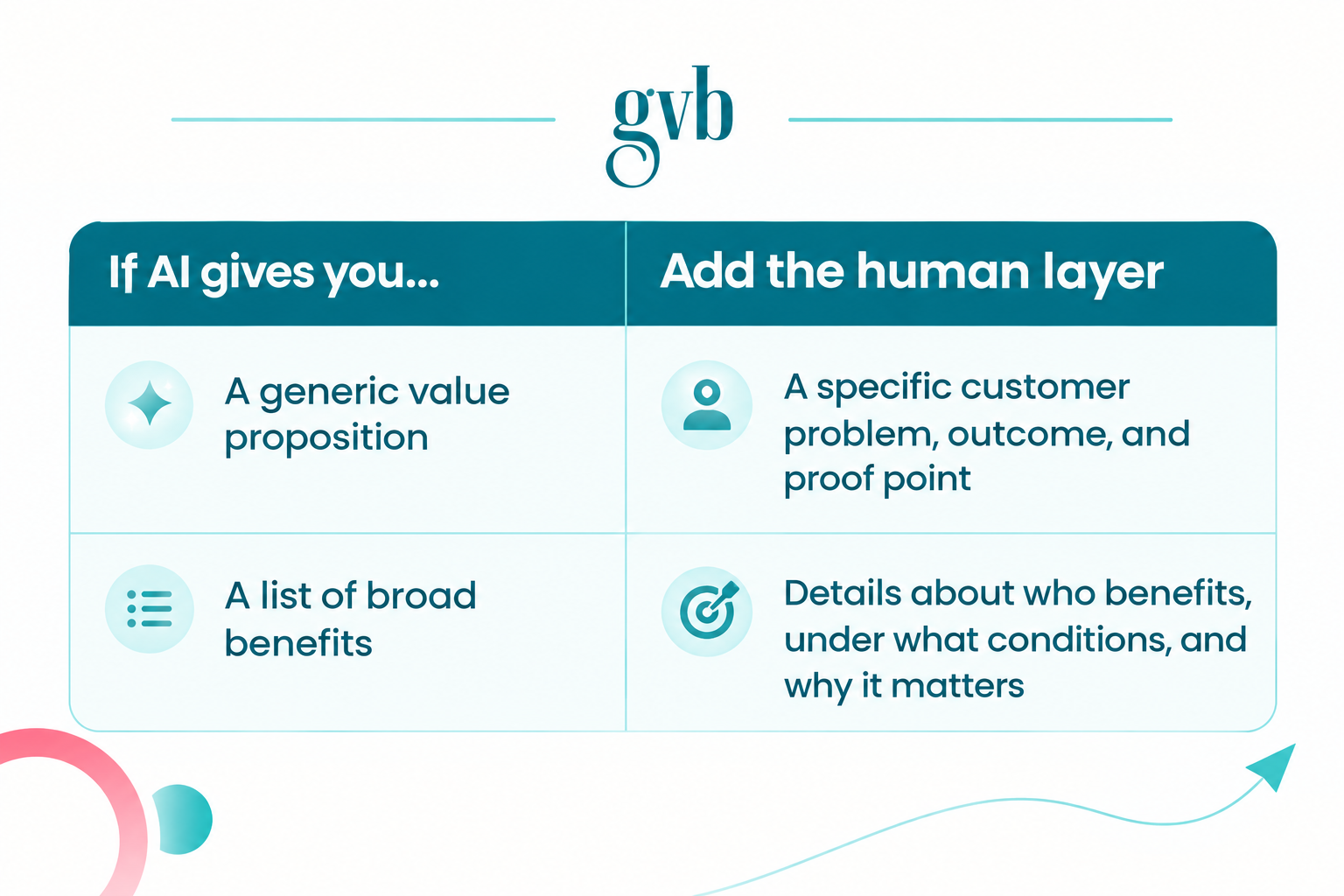
Does it include a specific customer problem, lived example, or firsthand insight?
Does it add something useful or original — not just a polished version of what’s already online?
Does every claim, statistic, quote, date, and link check out against a reliable source?
Does it directly answer the audience’s question or help solve a real problem?
Does the language sound recognizably like our brand?
Are the examples credible, specific, and free of made-up details?
Has a subject-matter expert challenged the assumptions, checked the nuance, and flagged anything misleading?
Would a real person find this genuinely helpful, or can they tell it was written to fill a content calendar?
If any answer is no, the content needs another human pass. Humanizing AI content is not merely a matter of making it sound less robotic; it means putting human judgment, expertise, evidence, and accountability behind every published claim.
can AI replace human creativity?
AI can assist with language, but it cannot replace the creativity, context, and accountability that human experts bring to content.
Remember my story? The value of content doesn’t come from arranging words into grammatical sentences. It comes from human experience and connection: years of reading, revising, listening to clients, testing ideas, and learning what earns trust.
AI can imitate the shape of expertise, but it cannot supply the experience behind it. Use the tool to accelerate the work; rely on people to decide what is true, useful, distinctive, and worth saying.